‏إظهار الرسائل ذات التسميات Causes. إظهار كافة الرسائل

الأربعاء، 20 أكتوبر 2010

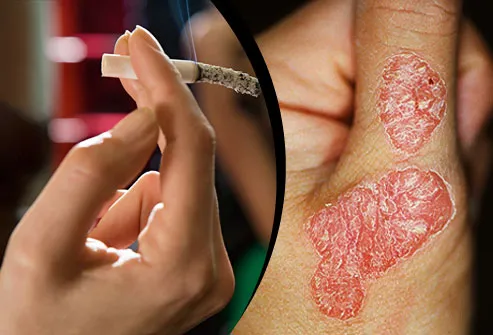
Smoking can trigger psoriasis


Cigarette smoking is a risk factor for many chronic diseases, including psoriasis, and it has been widely considered as an important preventable cause of morbidity. However, little is known about the effect of smoking on psoriasis severity. studies have shown that smoking more than 10 cigarettes per day by men who are psoriasis patients may be associated with a more severe expression of disease in their extremities. In addition, smoking among both men and women who are psoriasis patients has been shown to reduce improvement rates. These data demonstrate the importance of discouraging smoking, particularly among psoriasis patients.

Over 4,000 different chemicals are present in cigarette smoke. Many of these are carcinogenic, or capable of causing changes in the genetic material of cells that can lead to cancer. Cigarette smoke contains nicotine, an addictive chemical, and carcinogenic tars. Tobacco smoke contains many harmful  components such as carbon monoxides , nicotine and polycyclic hydrocarbons (ex benzo[a]pyrene)  . Cigarette smoking can induce several disease such as
1-Cardiovascular Disease, Coronary artery disease (2-4 fold risk) Stroke (2-fold risk) and Abdominal aortic aneurysm.
2-      Cancer, LUNG (90%), bladder, oral cavity, pharynx, larynx (voice box), esophagus, cervix, kidney, lung, pancreas, and stomach, and causes acute myeloid leukemia
3-      Lung,  chronic obstructive pulmonary disease [ COPD (>90%) ] , Other -including an increased risk for infertility, preterm delivery, stillbirth, low birth weight, and sudden infant death syndrome (SIDS) .

In a multicenter case-control study, they reported an increased risk of psoriasis among smokers and ex-smokers compared with subjects who never smoked. It has been hypothesized that excess mortality is also related to alcohol intake coupled with smoking among psoriasis patients. The effect of cigarette-years on psoriasis severity was stronger for women than for men.

It has long been known that smoking induces functional and morphologic alterations in polymorphonuclear leukocytes, and it may also cause an exaggerated release of chemotactic factors. Some studies have shown that cigarette smoking induces an overproduction of interleukin 1β and increases the production of tumor necrosis factor α and transforming growth factor β, which have been associated with psoriasis severity and support the dermatologist’s recommendation to patients with psoriasis to quit smoking to prevent worsening of their psoriasis.


الخميس، 14 أكتوبر 2010

Psoriasis Causes


CAUSES : The cause of the disease is still unknown. Viral, immune and metabolic theories are widely discussed, however in recent studies the scientific attention is focused on

Genetic predisposition
Approximately 40% of patients with psoriasis or psoriatic arthritis have first-degree relatives who are affected. The sibling occurrence risk is approximately 8%. Although concordance rates of psoriatic arthritis in twins are not yet known, a 65-72% concordance rate of psoriasis exists between monozygotic twins, compared with a 15-30% concordance for dizygotic twins. A 65-72% concordance exists between monozygotic twins compared with a 15-30% concordance for dizygotic twins.
The following important genetic susceptibility loci have been elucidated :
Early-onset psoriasis: HLA-Cw6, HLA-B57, HLA-DR7, and HLA-B17 with HLA Cw*0602 variant found to be highly associated
Psoriasis: HLA-Cw6 (or psoriasis susceptibility 1 [PSOR1] on chromosome 6) and 6 other psoriasis susceptibility loci (PSOR2, PSOR3, PSOR4, PSOR5, PSOR6, PSOR7), transcription factor RUNX1
Psoriatic arthritis: HLA-B7, HLA-B27, HLA-DR4, HLA-38, HLA-DR7
Psoriasis and psoriatic arthritis: HLA-Cw6, HLA-B13, HLA-B17, HLA-B57, and HLA-B39
Predictors for gene progression: HLA-B39; HLA-B27 in the presence of HLA-DR7; HLA-DQ3 in the absence of HLA-DR7
Protective: HLA-B22
The following associated gene polymorphisms are also thought to be associated with psoriasis and psoriatic arthritis:
TNF-alpha promoter
MHC class I-chained related gene A (MICA)
Caspase-activating recruitment domain (CARD) 15
Interleukin (IL)–12/IL-23p40 and IL-23 receptor
Triggering factors
(mechanical, thermal, electromagnetic, and changes in season and climate etc), Winter tends to be the most challenging season for persons suffering from psoriasis. It has been observed that cold weather is a common trigger for many people whereas on other hand a hot and sunny climate tends to clear the skin. Sunburn on the other hand, can act as a triggering factor for psoriasis.
Skin Injury
People with psoriasis often notice new lesions 10 to 14 days after the skin is cut, s c r a t ched, rubbed, or severly sunburned. This is called Koebner's phenomenon ( The so-called Koebner phenomenon in psoriasis may be initiated by the release of proinflammatory neuropeptides in the traumatized human skin[8] ) . All types of trauma have been associated with the development of psoriasis especially plaque psoriasis, Even excessive scratching can aggravate or precipitate localized psoriasis.
Infectious
Candida albicans (thrush), Human immunodeficiency virus (HIV) , Staphylococcal skin infections (boils) S t r e p t o c o c c a l p h a r y n g i t i s (streptococcal throat) , Viral upper respiratory tract infection
[ Advices for living with HIV ] Medicamentous
Anti-malarial drugs - It has been observed that psoriasis may develop after taking an anti-malarial medication in some persons
Beta-blockers (medication used to treat high blood pressure) and heart medication - These worsen psoriasis in some people.
Non-steroidal medications - used to treat arthritis and other inflammatory conditions may worsen psoriasis in some people.
Lithium used to treat manic depression and other psychiatric conditions aggravates psoriasis in many persons. And also drugs like -  (tetracyclines, ACE inhibitors,corticostertoids.)
Emotional stress and Hormonal disturbance
especially in association with hormonal disturbance, is an endogenous triggering factor. Some of the research studies have shown that the severity of psoriasis may fluctuate with hormonal changes. Disease frequency peaks during puberty and menopause. When hormone levels increase during pregnancy, symptoms are more likely to improve than worsen. In contrast, symptoms are more likely to flare in the postpartum period, if any changes occur at all
 Smoking: An increased risk of chronic plaque psoriasis exists in persons who smoke cigarettes.
Alcohol consumption: Alcohol consumption is considered a risk factor for psoriasis, particularly in young to middle-aged males. See also more psoriasis triggers slides