الخميس، 14 أكتوبر 2010

Winter and psoriasis

Enter your email address:


Winter brings dry air, colder temperatures, and reduced exposure to sunlight – all of which can worsen the symptoms of psoriasis. What about people who affected with psoriasis to prevent a flare-up of symptoms. What will you do in the winter ?

Think Twice About Long, Hot Showers

Make your showers short, sweet, and lukewarm, Avoid hot water, Hot water feels good at the time, but the itching can rebound when you get out . Use soaps for sensitive skin.

Use Moisturizer After Baths and Showers

Dermatologists and other health professionals who care for psoriasis patients recommended using Moisturizer and One of the best times is after a shower. Put moisturizer on your skin 3 to 5 minutes after you towel off after a shower . It helps seal in moisture so the skin doesn't get as dry . Lotions are easiest to apply all over. But creams and ointments are more moisturizing than lotions .

But you can ask your self what your body need  ( which is more dry in your body ) , creams can used in acute irritant state then complete with ointment, what about the time of application in evening or night . You can use it at night or after a shower, and wear old sweats or pajamas. It will soak in after an hour or two.

Look to the Light for Therapy

The use of light therapy can help clear up patchy, scaly skin. phototherapy, light therapy has been a standard of psoriasis treatment for a long time. The beneficial effects of a sunny vacation in the middle of winter could help ease psoriasis symptoms for a few months . One option is called psoralen UVA, or PUVA. "It is a type of photo chemotherapy, in which the patient takes a light-sensitizing medication, psoralen, by mouth, then an hour and a half later is exposed to long-wave, ultraviolet light in the office . according to the National Psoriasis Foundation, and there are long-term risks of skin cancers with light therapy, so that risk must be weighed.narrowband UVB or ultraviolet B. This type emits the part of the UV light spectrum most helpful for psoriasis and laser therapy .

Get a Winter Tune-Up on Your Psoriasis Medications

If your psoriasis is getting worse, or usually does in the winter, it is a great time to check-in with your physician for a medication tune-up. Your doctor can assess whether the psoriasis medications you are using -- topical, systemic, or a combination  are working as well as possible.
Common topical psoriasis treatments that you rub on your skin include over-the-counter products such as salicylic acid and coal tar such as Psorent, and prescription topical creams such as Dovonex (synthetic vitamin D3), Tazorac, and corticosteroid medications.
Systemic psoriasis medications include methotrexate, which you can take as a pill, and new injected drugs called "biologics," such as Enbrel and Humira. Remicade another biologic, must be infused at the doctor's office. By adjusting doses or medicine types, you may get more psoriasis relief in winter.

Check your Stress

Stress plays a big part in making psoriasis condition worse, The stress can be emotional or physical . Take time to eat healthy, exercise, and do whatever you think is stress-reducing . Most people who have lived with psoriasis for a long time are aware with stress .

Flu Vaccination / flu shot for Psoriasis Patients

There are some special considerations for psoriasis patients regarding flu vaccination. Flu vaccination is especially important for people whose immune systems are suppressed. So for psoriasis patients who are on methotrexate, cyclosporine, or other immune-suppressing drugs, a flu vaccination is a particularly good idea. Vaccination could make psoriasis worse in some patients, but this effect is not usually a strong one. Psoriasis patients also sometimes develop psoriasis lesions at sites of injury (Koebner phenomenon) and thus could develop a lesion at the site of a vaccination injection.

Flu vaccine uses killed virus. Thus it doesn't cause infection. Vaccines that involve "attenuated" live virus are risky in immunosuppressed patients. This is a problem with smallpox vaccination, and patients who are on immunosuppressive drugs should avoid such vaccination. Also, the family of immunosuppressed people should avoid the vaccination because of the potential for transmission of the virus to the immunosuppressed person. Finally, smallpox vaccination is not recommended for anyone with inflammatory skin disease for fear that the virus will spread over the irritated skin areas. This is not a problem with the flu vaccine because the flu vaccine does not contain live, infectious virus.

I tend to eat more and drink more alcohol in the fall and winter months. Will this affect my psoriasis?  Alcohol and key foods certainly could trigger a psoriasis flare. Though medical researchers have yet to prove that certain foods cause psoriasis flares, many patients report that eating certain foods seems to worsen their psoriasis. If you notice a regular connection between eating certain foods and increased skin symptoms, ask your doctor whether you can safely eliminate the suspect foods from your diet to assess any changes in your psoriasis . If you tend to smoke when you drink, you might be dealing yourself in serious problem . Evidence indicates that people who smoke tobacco products may be more likely to develop a form of psoriasis. Researchers have also found a correlation between smoking and more serious forms of psoriasis.

Could strep throat and other winter illnesses affect my psoriasis?  If you suffer from psoriasis, an infection by bacteria and viruses can cause symptoms to flare. A strep infection, specifically, is a known trigger for guttate psoriasis, a form of the disease that causes red, droplet-shaped lesions to develop on the abdomen, back, arms, and legs.

Although researchers don’t know the exact cause of psoriasis, the immune system seems to play a key role in its development. Germs, illness, viruses or bacteria – anything that dampens your immune system -- may cause your symptoms to worsen. Even something as simple as a common cold or respiratory virus may trigger a psoriasis flare.
What types of clothing are best for people with psoriasis in cold weather?   Wool sweaters are synonymous with winter for some people with psoriasis, but the itchiness of the fabric may make your already irritated skin feel worse
Consider dressing in layers made from natural plant fibers, such as cotton, to keep you warm and comfortable. If you suffer from scalp psoriasis and find that flaking is a problem, choose lighter-colored clothes to hide dandruff.
To make your holiday season an enjoyable one, make every attempt to enjoy the time spent with family and friends and follow as healthy a lifestyle as possible.  It’s the best present you can give to yourself.

Stress and psoriasis

Enter your email address:


Studies have shown that stress and psoriasis go together. And while stress is known to make psoriasis worse, psoriasis can make you more stressed out. some particular stress-induced effects on circulating lymphocytes with implications for the cutaneous inflammation in this chronic relapsing skin disease.
Stigma.  People living with psoriasis can become self-conscious and ashamed.  Everyday social interactions can become stressful, from going on a date to merely shaking someone's hand.
Finances.  Lots of psoriasis treatments can be expensive. A year's worth of biologic medicines can cost over $25,000. And the costs of even the cheaper treatments can add up.
Pain. Psoriasis can cause chronic pain, which adds a constant level of stress in your life.  Sometimes, that pain -- especially with psoriatic arthritis of the hands -- can seriously interfere with your ability to do day-to-day activities.
Treatment. Unfortunately, treatment itself can be stressful. Some therapies require a lot of commitment -- phototherapy sessions might be five times a week for up to a year. Trying to fit that into your schedule isn't easy. Coping with the side effects of a drug can be stressful. And of course, there's nothing more frustrating than trying a treatment for months that doesn't end up working.
Life with disease. Psoriasis is a chronic condition. There is no cure. When it's bad, psoriasis can wear you down. Even when you're doing well, you might still find yourself anxious about the future. What if it gets worse again?

Tips for Coping

Use relaxation techniques.  Many practices -- like deep breathing, meditation, tai chi, and yoga -- can make a big difference for people with psoriasis. In some cases, it may actually help with treatment. One study found that people receiving light therapy while listening to meditation tapes did twice as well as people who just got the treatment. Obviously, simpler stuff -- like long walks or long baths -- can help relax you too.
 Benefits of relaxation technique

Get a massage.  Many people suffering with stress and psoriasis find that massage is a good way to ease tension. Massage includes specific techniques like acupressure and reflexology. When looking for a masseuse, you might want to find one who has previously worked with people who have psoriasis. 

Have trust in your doctor. To reduce stress, you need to have confidence in your treatment -- and that means faith in your doctor. You must have a good working partnership. If you don't, or if you have doubts about your treatment plan, don't hesitate to get a second opinion.

Get professional help. If you're finding the stress and psoriasis hard to handle -- or are worried that you're developing clinical anxiety or depression -- schedule an appointment with a therapist.  Therapists can help you cope with some of the intense emotional issues that stem from life with psoriasis. But he or she can also give you more practical tips on ways of reducing stress.

Get better treatment. Yes, treatment can be a cause of stress for people with psoriasis.  But it can also be the best cure for both your stress and psoriasis. If you have good control of your condition and can resolve the symptoms, you're removing the core cause of your stress.
If you're in severe depression or stress you can use antidepressant drugs after taking your doctor advice about these drugs .  It has been published reports of improvement of atopic dermatitis with topical application of the strongly antihistiminergic tricyclic antidepressant doxepin and of psoriasis with oral administration the tricyclic antidepressant imipramine ,with the monoamine oxidase inhibitor moclobemideand with bupropion-SR .

Antidepressants have neuroendocrine and immunologic effects including decreasing natural-killer cell activity and inflammatory response in mice; decreasing macrophage migration and hypersensitivity reactions in rats; and in humans, altering concentrations of opioid peptides and beta-endorphin concentrations in lymphocytes, suppressing natural-killer cell activity altering interferon/interleukin production ratios normalizing the chronic hypothalamic-pituitary adrenocortical (HPA) axis overactivity in patients with depression , and inhibiting the substance -P inflammatory response in skin . the skin and brain are derived from embryologic cell populations adjacent to the neural crest there is enough commonalty between these tissues that bupropion may have specific effects of its own on adrenergic receptors in dermal or epidermal tissue.
It's reported that Pharmacological treatment of depression secondary to cytokine administration has included antidepressants, opiate antagonists, stimulants and corticosteroids. Serotonin selective reuptake inhibitors as well as tricyclic antidepressants have been used to treat and prevent IFN-α induced depression .
Administration of anti-depressant drugs is reported to result in immune system changes (i.e., decreasing expression of inflammatory mediators) suggesting a link between increased inflammatory mediator expression and disease. In support, cytokine antagonists have been administered to patients with chronic inflammatory disorders to alleviate physical illness as well as symptoms of concurrent depression. Administration of anti-cytokines (e.g., TNF-α) is reported to clear up psoriatic lesions and relieve symptoms of fatigue and depression in patients with psoriasis. Although speculative, this suggests an association between increased pro-inflammatory cytokines and pathogenesis of depressive disorder.

Daily tips for psoriatic patient

Enter your email address:


If you're one of the millions of people with psoriasis, you already know your skin is dry, itchy, and sore. You can reduce psoriasis flare-ups, remove scale, promote healing, and soothe that itchy, irritated skin with a few simple psoriasis skin care tips which associated with recommended diet and drugs .

Moisturize

moisturize -- this is one of the simplest and most effective things you can do for your skin when you have psoriasis. Keeping skin moist helps reduce dryness, itching, redness, soreness, and scaling.

Moisture can also help your skin heal Which moisturizer you use depends on how dry your skin is. Ointments are thick, heavy, and good at locking moisture in, while lotions are thinner and smooth on easily. Creams fall somewhere in-between. Fortunately, you don't have to use high-priced moisturizers for your psoriasis skin care. Some people use petroleum jelly as an economical substitute. Whichever moisturizer you use, pat it on gently after bathing, and reapply during the day as needed -- especially if it's particularly cold or dry out.

Good psoriasis skin care means avoiding harsh products that can irritate it even more, such as lotions containing alcohol, deodorant soaps, and even some laundry soaps. Scratchy, rough clothes can also aggravate your skin, so try switching to softer, less irritating cotton-based clothing (cotton).

Daily Baths

Baths are another easy way to help care for your skin when you have psoriasis. A daily warm bath using a mild soap can help soothe itchy spots and make it easier to remove dry skin. Add oil, colloidal oatmeal, Epsom salt, or Dead Sea salt, herbal baths ( chamomile and clandula ) to the water and soak for 15 minutes for even more relief. Steer clear of hot water or harsh soaps while you bathe. They may irritate and dry already-stressed skin. After your bath or shower, gently pat your skin dry instead of rubbing. Rubbing your skin not only irritates existing lesions, it can also cause new ones. After you pat your skin dry, smooth on your moisturizer of choice.

Sunlight

A little ultraviolet (UV) light can go a long way in helping to sooth, improve, even heal psoriasis lesions. You can use artificial light to for UV therapy during the fall and winter months. The sun's rays are probably the easiest way to expose your skin to UV light's healing effects in spring and summer. But be careful: Too much sun (or sunburn) raises your risk of skin cancer and may make psoriasis outbreaks worse. Try moderate doses of UV exposure two or three times a week. Be sure to use sunscreen on the parts of your body that don't have psoriasis outbreaks. Talk to your dermatologist or doctor before adding UV therapy to your psoriasis skin care regimen, and then schedule regular skin checkups to be sure you're staying safe.

Reduce Stress

Studies show that stress can inflame psoriasis and increase itching. Some people even trace their first outbreak of psoriasis to a particularly stressful event. Of course reducing stress is easier to say than do, yet lowering stress may not only help reduce symptoms, it can give you a real sense of control, too. To reduce the stress in your life develop a personal support system, think positively, and take the time to identify what's important to you. Eating right, staying hydrated, and getting plenty of exercise can also help keep stress at bay -- and help you fight off the infections that may trigger flares.

Quit Smoking and Drinking

Smoking can trigger psoriasis flares, so quitting may improve your psoriasis, though it doesn't always help everyone. Talk to your dermatologist if you're smoker. Heavy drinking can also trigger psoriasis and make treatment less effective. Drinking can also lead to dangerous side effects when combined with certain psoriasis medications.

Stop Scratching and Picking
There's no doubt about it, itchy skin begs to be scratched. Yet scratching can tear open the skin, making way for infection-causing bacteria. To make the situation worse, scratching may cause lesions to appear where they weren't before. Picking your skin creates the same hot bed for infection.
See also psoriasis at home treatment self care tips
 
Nails 
As finger and toenails are very often affected by psoriasis, the treatment of Nail psoriasis is part of the treatment of psoriasis. Approximately one third of patients may have a treatable fungal infection which could help their nails to improve. As a Koebner phenomenon may occur with this type of psoriasis, preventing prevent further damage to the nails is important. Some things to keep in mind include keeping the nails trimmed as a means to prevent rubbing and more irritation; soaking and carefully filing down and moisturizing thickened toenails, and wearing shoes that are comfortable and fit well with enough room to eliminate pressure and friction on the toenails.
 
Trimming the nails to remove all of the affected area is useful in preventing infection of the nail beds. Both olive oil and tea tree oil have good anti-fungal and antibacterial properties. A variety of treatments used for skin psoriasis treatments are also used to improve Nail psoriasis. Discussing these treatments and the many more options with your physician will help you find the best treatment.

  
Scale removal
The removal of excessive dead skin as it forms on a daily basis is very useful as a preventative measure against excessive buildup. The build up of dead skin (scale) can lead to the formation of large, deep platelets which will cause discomfort and pain in daily activities. A softening agent, such as salicylic acid, can be used to ease and remove plaques soften and remove scale. After bathing, the scale will be softened, and then it can be removed by rubbing with a clean cloth. But care should be taken not to break the underlying skin. Equal parts of extra virgin olive oil and Vaseline can be mixed (check for sensitivity before use) as a great emollient to contain moisture in the skin as well as lubricate the skin after bathing.


Cytokines and psoriasis

Enter your email address:


Psoriasis is an immune dysfunction disease associated with abnormal level of cytokine .It’s associated with (elevated level TNFα, IFN- γ, IL-la , IL-13, TGF-β1 , IL-6, [53] , IL-2, IL – 7, IL - 18IL – 4, IL - 10 vascular endothelial growth factor ( VEGF )and other cytokines in lesional skin ).

It has been suggested that the expression of IL-12 might play an important role in certain inflammatory skin diseases. Psoriasis vulgaris is a chronic inflammatory type cytokine-related cutaneous disease, which is characterized by infiltrates of activated memory T cells that have a high IFN- γ expression. An enhanced expression of IL-12 mRNA and protein was found in psoriatic lesional skin compared with nonlesional and normal skin, and a causative relationship to the high IFN- γ expression in lesional skin was suggested. IL-23 was found during a genome scan for the IL-6/IL-12 cytokine family.

 IL-23 is a heterodimer, sharing a p40 subunit with IL-12 but having a distinct p19 subunit.IL -23 binds to IL-12Rβ1 but not IL-12Rβ2. The receptor for this cytokine is heterodimeric and uses a novel second subunit, IL-23R, which is a member of the hematopoietin receptor family. IL-23 plays a role in type 1-polarized T cell immune responses. IL 23 is produced by activated dendritic cells ,macrophages and keratinocytes. IL-23 amplifies and stabilizes a new CD4(+)T-cell subset, Th17 producing IL-17.

In other study state that that cutaneous resident DCs, LCs, and dermal DCs are capable of inducing distinct IL-22- producing CD4+ T cells, possibly Th22, from both whole peripheral T cells and naive T cells. Until very recently, IL-22 had been considered a Th17-associated cytokine. Indeed, in previous studies, although Th1 cells produced more IL-22 in comparison to Th2 cells or unpolarized T cells, Th17 cells were clearly the dominant IL-22 producers at both mRNA and protein levels . These data established that IL-22 was an effector cytokine of Th17 cells. Indeed, psoriasis skin lesions contain a population of T cells that cosynthesize IL-17 and IL-22, but the majority of IL-22-producing T cells are neither Th17, Th1, nor Th2 .

 In AD, there is an even larger population of T cells that uniquely synthesize IL-22 . Moreover, two independent groups have recently identified a human helper T cell population producing abundant IL-22 that is distinct from Th17 and Th1 . In their paper, Trifari et al. named this unique population Th22 . The unique characteristic of DCs is their ability to polarize naive helper T cells into Th1, Th2, and Th17 cells. DCs reside in antigen-capture areas related to epithelial surface and secondary lymphoid organs . Indeed, using activated conventional DCs and plasmacytoid DCs, Trifari et al. have also demonstrated that human

DCs actually induce the development of Th22 cells from naive T cells . According to their results, plasmacytoid DCs are more powerful than conventional DCs in the expansion of Th22 cells. However, it was unknown whether tissue resident DCs, including cutaneous DCs, were actually able to induce this unique IL-22-producing helper T cell population. Thus, in this study is unique evidence illustrating that tissue resident DCs can induce the differentiation of Th22 cells. State that LCs and dermal DCs are able to induce IL-22-producing T cells lacking IL-17 production at least conditionally. Stimulation of keratinocytes with IL-22 leads to the induction of antimicrobial peptides, such as S100A7 and β-defensin . In addition, this cytokine has much stronger effects in regulating hyperplasia and differentiation in keratinocytes . In vitro, IL 22 induces marked acanthosis and hypogranulosis and suppression of terminal differentiation of cultured reconstructed epidermisIt has also been reported that polarization of Th22 cells is largely, but not completely, dependent on IL-6 and TNF-α

TGF-β1 levels increased in plasma and scales of psoriatic patient , TGF-β1 can induces T-cell migration , chemoattractant for neutrophils and monocytes / macrophages in early stages of infection and induces monocytes to express CD16 , thereby predisposing these cells to become migratory CD86+ DCS. In skin ,thes proinflammatory  processes can overcome antiprloferative effects that TGF-β1 exerts directly on keratinocytes and can lead to the development of psoriasis- like disease in mice.

Although the simultaneous presence of IL-17 and IL-22 has been proposed to be the “signature” of Th17 cells, PGE2 enhances IL-17 and decreases IL-22 production and are reminiscent of a similar dissociation observed in mouse Th17 cells generated in the continuous presence of TGF-β and IL-6 opposed to priming in the presence of TGF-β and IL-6 followed by expansion in IL-23. IL-22 is considered a proinflammatory cytokine with a distinct role in the generation of psoriatic skin lesions.

In other study it reported that serum levels of proinflammatory cytokines (TNF- α, IL-2R and IL - 6 ) in psoriasis vulgaris In patients which are of major clinical relevance to the clinician and their correlation with severity of psoriasis. some particular stress-induced effects on circulating lymphocytes with implications for the cutaneous inflammation in this chronic relapsing skin disease .

Immunologic mechanism of psoriasis


Psoriasis is an autoimmune disorders or a T-helper (Th1) / (Th17) immune dysfunction.T-cell activation, TNFα, and dendritic cells are pathogenic factors stimulated in response to a triggering factor, such as a physical injury, inflammation, bacteria (A self-peptide cross-reacting with streptococcal M protein bacteria-derived superantigens is one of the candidates as streptococcal infections precede 90% of psoriasis type I cases), virus retrovirus (human immunodeficiency virus 1), and human papilloma virus, or withdrawal of corticosteroid medication. 

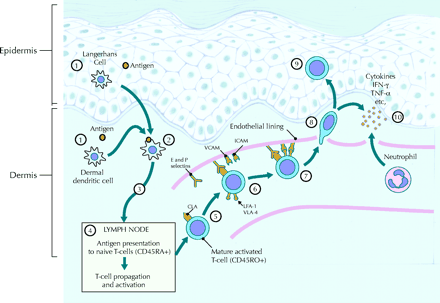
Initially, immature dendritic cells in the epidermis stimulate T-cells from lymph nodes in response to as yet unidentified antigen stimulation . Dendritic cells (DC) act as antigen-presenting cells (APC) to initiate the immunoresponse after stimulation by an as yet unknown signal. Activated DCs migrate to lymphatic tissue and secrete chemokines to attract naive T lymphocytes, which are then activated and differentiated to Th1 and Th17 type cells. Movement of the activated T lymphocytes from the periphery to the skin is elementary for the plaque to develop.  the dendritic cells (DC) are the most common type of antigen-presenting cells.

Antigens are presented on the DC surface usually as MHC class II molecules, which can be recognized by T cell receptor of CD4+ T cells. In addition DCs can present antigens on MHC class I molecules, which lead to the activation of CD8+ T cells. DCs also enhance the production of adhesion and co-stimulatory molecules to facilitate its interaction with T cells. The antigens behind the process are not known.

Naive T cells have to go through maturation in lymphatic tissues. CD4+ T cells have a strong affinity to MHC II-peptide complex and they stick together by forming an immunological synapsis. Interaction between ICAM-1, produced by DCs, and LFA-1(lymphocyte function associated antigen 1), from T cells, is one of the most important in order to facilitate the DC-T cell interaction. Naive T cells can mature either to Th1, Th2, Th17 or regulatory T cells and subtype is guided by the selection of a soluble mediator present during the activation of naive T cells. After the activation, T cells express cutaneous lymphocyte-associated antigen (CLA) (cutaneous lymphocyte antigen), which directs T cells to inflamed skin. P- and E-selectins expressed by endothelial cells are also important for T cell skin homing. The invasion is based on tissue-specific ligand receptor interaction and on that account skin homing T cells produce L-selectin, LFA-1 and CLA adhesion molecules.

Resident skin cells also express molecules important in skin homing, including ICAM-1 (intercellular adhesion molecule 1) expressed by epidermal keratinocytes and E- and P-selectins in dermal capillaries. The initial interaction is formed between the L-selectin of T lymphocytes and E- and P-selectins expressed by vascular endothelial cells, after which other ligand-receptor interactions also emerge to continue the inflammation reaction.

Interaction between P- and E- selectins and CLA, as well as other selectin ligands, facilitate leukocytes rolling along the blood vessel wall as they decrease the rolling velocity as T cells recognize chemokines secreted by the endothelial cells, become active and a tight adhesion, facilitated by integrins produced by T cells and their ligands expressed by endothelial cells, is formed between the cells. The most important molecule in skin homing is LFA-1 binding to ICAM-2.

T cells probably enter the endothelial wall through pores formed between endothelial cells in an integrin-dependent process called diapedesis. Both CD4 and CD8 positive T lymphocytes are in psoriasis plaque, CD8+ cells predominantly within the epidermis and CD4+ cells within the dermis. Especially the role of CD4+ cells is critical in the pathogenesis of psoriasis. Other inflammatory cells also take part in pathogenesis but their role is not as well understood. Both macrophages and mast cells produce cytokines including tumor necrosis factor (TNF), interferon γ (IFN-γ) and interleukin 8 (IL-8), which are essential for psoriasis.

Psoriasis is commonly considered to be a Th1 type disease and cytokines of the pathway, including IL-2, IL-12, IFN- γ and TNF-α, are abundantly found in psoriasis plaques Interleukin-2 is a T cell growth factor, which promotes T cell function, as well as stimulates natural killer cell activity, and promotes production of a wide variety of cytokines Interferon γ is an important immuneregulator and also has antiproliferative properties. Furthermore it can induce the expression of ICAM-1 in keratinocytes and endothelial cells and thus influence invasion of skin homing T lymphocytes in psoriatic skin .

Tumor necrosis factor α is produced by keratinocytes and has a focal role in skin inflammatory processes  Proinflammatory cytokines IL-6 and IL-8, capable of promoting keratinocyte proliferation, are also expressed abundantly in psoriatic skin . Recent additions to the list of cytokines relevant in psoriasis are IL-12 and IL- 23. In psoriatic skin IL-23 is overproduced by DCs and keratinocytes and promotes Th 17type T cells‘ survival and the production of IL-17 and IL-22, which are also considered to be significant in psoriasis .

Interleukin 17 promotes accumulation of neutrophils, dendritic cells and T cells and also has an impact on barrier function. Interleukin-22 triggers keratinocyte hyperproliferation and down regulates genes associated with keratinocyte differentiation, which are functional aspects relevant for the pathogenesis of psoriasis.

Interleukin-12 participates in several processes relevant for psoriasis including cell proliferation and angiogenesis. It also promotes T lymphocyte activation and differentiation by promoting the Th1 pathway . In addition to the aforementioned cytokines, other cytokines as well as chemokines are found and may have an impact on the pathogenesis of psoriasis.

Toll like receptors (TLRs) of non clonal pattern recognition receptors, which  recognize constitutive and conserved molecular patterns shared by many pathogens. TLRs are important in the early recognition of microbial structures. They signal via the transcription factor genes. TLR1, TLR2 and TLR5 were shown to be  than that in the normal epidermis. These changes differentiation pathway or result from the effects of proinflammatory cytokines such as TNF-α and IFN-γ present in psoriatic lesion .

Fasting improve psoriasis

Fasting is elimination food and drink for periods of time either therapeutic or religious. A fast does not chemically begin until the carbohydrate stores in the body begin to be used as an energy source. The fast will continue as long as fat and carbohydrate stores are used for energy . Fasting takes various forms like dry fasting without food and drinks, Juice Fasting involves abstinence from all food and drink except water and pure vegetable and fruit juices and Modified Fasting includes small amounts of food, usually raw fruits and steamed vegetables or the use of herbal teas or broths.
Benefits of fasting

Detoxification is a normal body process of eliminating or neutralizing toxins through the colon, liver, kidneys, lungs, lymph glands, and skin. This process is enhanced by fasting. Undesirable chemicals (like DDT, BHA, Sodium Benzoate, Polysorbate-80 etc.) which body absorbs through environment or through consumption of various food items, are stored in fat reserves of body. During fasting the body turns to fat reserves for energy. In the process it releases these chemicals from the fatty acids into the system which are then eliminated through the aforementioned organs.

Healing Process is precipitated as body search for energy sources and conserves intelligently. During fasting energy is diverted away from the digestive system and towards the metabolism and immune system. Abnormal growths within the body, like tumors, cyst, fibroids etc. do not get the necessary support of the body's supplies and therefore are more susceptible to autolysis. Production of protein for replacement of damaged cells occurs more efficiently. A higher efficiency in protein synthesis results in healthier cells, tissues and organs. This is one reason that animals stop eating when they are wounded, and why humans lose hunger during influenza. Efficiency in hormone production significantly improves during fasting, hence releasing growth hormones and anti-aging hormones.


It is easier for your body to maintain homeostasis when you are resting and fasting than when you are eating and engaging in activity. Fasting is also required to get accurate readings for certain medical tests. Short-term fasting before tests for cholesterol and blood sugar levels, for example, helps achieve a more accurate baseline count.

Fasting advocates also claim that the practice can effectively treat serious health conditions, from arthritis and colitis to heart disease , depression and healthier skin.  If therapeutic fasting associated with  dietary modification, omega-3 supplementation, topical, natural medicines, herbal medicine, and stress management ,psoriasis will be improved as well as results from drugs .

During fasting, some patients with psoriasis experienced an improvement, which persisted during the vegetarian diet. The direct cause of these positive effects is not sufficiently explained, and various mechanisms are discussed. The most important reason is probably the lack of arachidonic acid (AA) intake, resulting in lower leukotriene (LT) B4 production . During fasting, CD4+ T-cell activation is reduced and anti-inflammatory cytokines such as interleukin (IL)-4 increase. Another reason may be a reduction of oxidative stress due to calorie restriction, because psoriasis appears to be associated with oxidative stress . A vegetarian diet may be beneficial because it is associated with a reduced AA intake. As psoriasis is positively connected with body mass index (BMI), weight reduction is recommended for obese patients. Short-term fasting periods may improve severe symptoms and thus can be suggested for patients with a BMI in the upper range. So therapeutic fasting may added to the diet regimen during treatment of psoriasis .

رسائل أحدث رسائل أقدم الصفحة الرئيسية